
7 Best AI Data Analytics Platforms for Live Databases
TL;DR: The best AI data analytics platform depends on where your data lives. For a data team on a warehouse, Hex. For a free self-hosted option, Metabase. For files plus light database work, Julius AI. For governed search at scale, ThoughtSpot. For teams without a data team who want live database answers and alerts, AI for Database. Already on Microsoft Fabric, Power BI Copilot. Flat-rate for up to 25 users, Basedash.
An AI data analytics platform is software that lets you ask questions about your data in plain English and get back answers, charts and dashboards, with AI writing and running the queries. The split that matters most is whether the platform queries your live database (PostgreSQL, MySQL, Snowflake, BigQuery) or only analyzes files you upload. Many "AI analytics tools" lists mix both, and many platforms that do connect to databases put that connector behind a higher plan. This page compares seven platforms on exactly that: which sources they query live, which plan unlocks database access and AI, and what it costs a five-person team, using vendor pricing pages checked on November 12, 2026.
What does an AI analytics platform do?
An AI data analytics platform combines three things: a connection to your data, a language model that turns questions into queries (usually SQL), and a layer that shows the result as a table, chart or saved view. Some stop at a chat reply; others save the result so it can be reused.
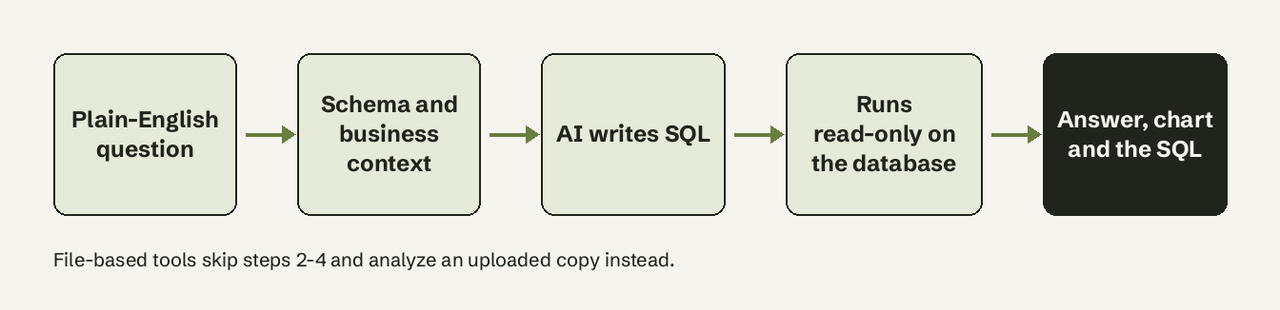
Platforms differ in four ways:
- Source: live database or warehouse connection versus uploaded CSV and Excel files.
- Who it is built for: data teams who write SQL and Python, or business users who never will.
- What happens after the answer: a one-off chat reply, a saved dashboard, or a scheduled alert.
- Pricing model: per editor, per user, flat rate, or credits and capacity.
How we judged them
We judged each platform on five criteria, with live database access weighted most:
- Live database access: does it query PostgreSQL, MySQL, Snowflake or BigQuery directly, and on which plan?
- Who can use it: can a non-technical user get an answer without help?
- Trust: does it show the SQL or logic behind each answer?
- Beyond the answer: dashboards, scheduled runs, alerts.
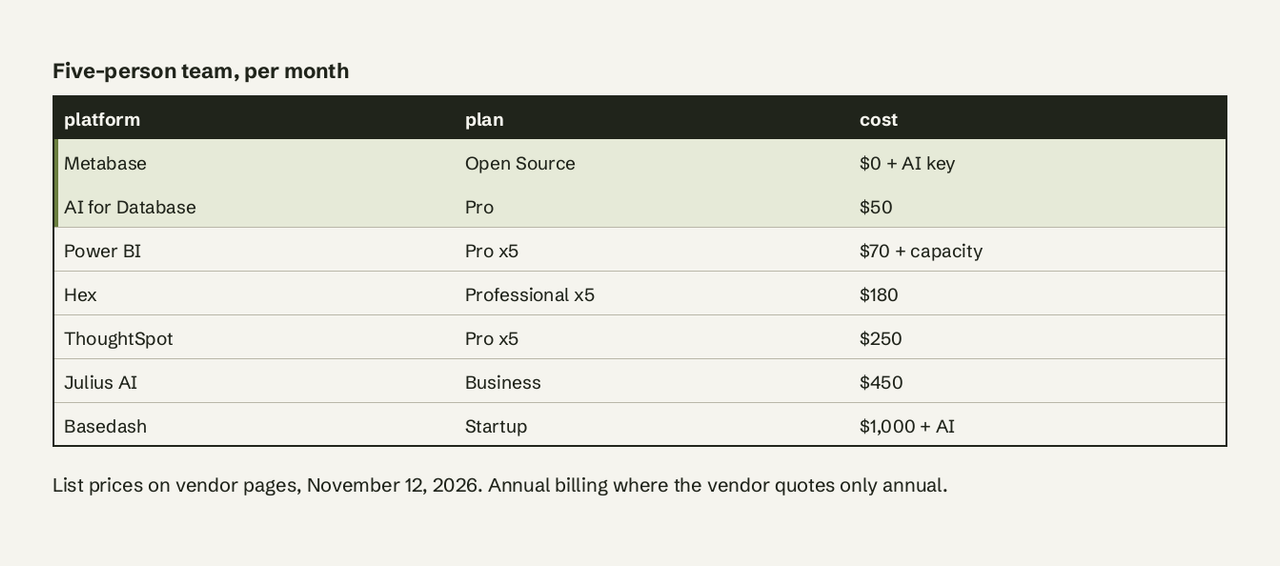
- Price for a small team: published price for five people, from each vendor's pricing page.
We did not include tools that only generate SQL text without running it, or file-only chat assistants, as numbered picks. ChatGPT and Claude get their own section below.
Summary table
| Platform | Best for | Live DB access | Cheapest plan with AI on a database | Approx. cost, 5 people |
|---|---|---|---|---|
| Hex | Data teams on a warehouse | Yes, all plans | Professional, $36/editor/mo | $180-$375/mo |
| Metabase | Free self-hosted BI with AI | Yes, 20+ sources | Open Source, free (bring your own AI key) | $0 self-hosted, $100/mo cloud |
| Julius AI | Files plus light DB analysis | Snowflake, BigQuery, Postgres from Plus | Plus, $20/mo | $450/mo (Business, shared) |
| ThoughtSpot | Governed search at scale | Yes, modeled sources | Pro, $50/user/mo (annual) | $250/mo |
| AI for Database | Teams without a data team | Yes, 10+ databases and apps | Pro, $10/user/mo | $50-$150/mo |
| Power BI Copilot | Microsoft Fabric shops | Via semantic models | Pro $14/user + F2 or P1 capacity | $70/mo + capacity |
| Basedash | Flat rate for up to 25 users | Yes, 750+ sources | Startup, $1,000/mo + AI usage | $1,000/mo + usage |
1. Hex
Hex is a notebook-based analytics platform where SQL, Python and no-code cells live together and turn into shareable data apps. Its Hex agent writes and edits queries for analysts, and business users can ask questions against data the data team has prepared.
- Best for: companies with at least one analyst who works in SQL or Python.
- Live database access: yes. Even the free Community plan says "connect any data source"; Enterprise adds OAuth database connections.
- Pricing: Community free (Hex agent trial only), Professional $36 per editor per month (Hex agent, up to 5 published apps), Team $75 per editor per month (scheduled runs and alerts, unlimited apps), Enterprise custom. Compute above Medium is extra, from $0.32 per hour (Hex pricing).
- Limits: scheduled runs and alerts start at Team; the notebook model assumes someone comfortable with code. Viewer access at scale (the Explorer seat) is an Enterprise add-on.
- Verified detail: compute profiles up to Medium (8 GB, 1 CPU) are free on all paid plans.
2. Metabase
Metabase is an open-source BI tool with a point-and-click query builder, SQL editor and dashboards. Its AI features let users ask questions in plain English using a model of their choice.
- Best for: teams who want free, self-hosted dashboards and can run a server.
- Live database access: yes, 20+ supported data sources on every plan, including the free one.
- Pricing: Open Source free with unlimited users when self-hosted. Cloud Starter $100 per month ($90 billed yearly) with 5 users included, then $6 per user; Pro $575 per month with 10 users included, then $12 per user. Most people connect their own AI provider key; Metabase's own AI service costs $3.75 per million tokens after 1 million free (Metabase pricing).
- Limits: self-hosting means you own upgrades, backups and security. Row and column permissions and SSO are Pro features. Alerts exist, but there is no workflow layer for webhooks.
- Verified detail: every person who signs in counts as a user, including people who sign in to embedded dashboards.
See our Metabase alternatives guide for where it fits and where teams outgrow it.
3. Julius AI
Julius AI is an AI workspace for analyzing data, research and creating reports and presentations. It started as a chat-with-your-spreadsheet tool and now connects to databases too.
- Best for: individuals who mostly analyze files but occasionally need a database.
- Live database access: the plan table lists Snowflake, BigQuery and Postgres connectors on Plus and above; the free plan connects only Google Drive, OneDrive and SharePoint. Julius says it natively supports Snowflake, BigQuery, MySQL, PostgreSQL and SQL Server, and builds a semantic layer of your schema as you query.
- Pricing: Free, Plus $20 per month (2,000 credits), Pro $45 per month (5,000 credits), Business $450 per month (60,000 credits, up to 50 members, "no table limit in data connections"), Enterprise custom (Julius pricing).
- Limits: credits meter all usage, including presentations, images and video. Team sharing (shared workspace, files and threads) starts at Business.
- Verified detail: Plus allows 3 scheduled runs; Pro and Business are unlimited.
Our Julius AI alternatives for databases covers the database side in more depth.
4. ThoughtSpot
ThoughtSpot is a search-driven analytics platform. Its Spotter AI agents answer natural-language questions over data models your team has set up.
- Best for: mid-size and large companies with modeled data and governance needs.
- Live database access: yes, over the sources and models it has indexed.
- Pricing: Essentials from $25 per user per month billed annually (5 to 50 users, up to 25M rows, dashboards). Pro from $50 per user per month billed annually adds Spotter AI agents, capped at 25 queries per user per month, for up to 1,000 users and 250M rows. A usage-based Pro starts at $0.10 per credit with unlimited LLM tokens. Enterprise is custom (ThoughtSpot pricing).
- Limits: the AI agent is not on Essentials; 25 Spotter queries per user per month is low for daily use on per-user pricing; annual billing only on the listed prices.
- Verified detail: ThoughtSpot says it does not meter or charge for LLM tokens on Pro and Enterprise.
5. AI for Database
AI for Database is an AI data-intelligence platform for teams without a data team. You connect your databases and tools, ask questions in plain English, and it runs the query, shows the answer with its SQL, pins it to a self-refreshing dashboard, and watches it with workflows that send Slack messages, emails or webhooks when a condition is met.
- Best for: founders, ops and revenue teams whose numbers live in a production database and who have no analyst to write queries.
- Live database access: yes, on every plan. PostgreSQL, MySQL, SQL Server, Oracle, SQLite, MongoDB, Redis, Firebase, Supabase, BigQuery and more, plus Google Sheets, Salesforce, HubSpot, Notion, Airtable and Slack. Answers are read-only.
- Pricing: start free with sample data. Pro $10 per user per month and Team $30 per user per month, both paid as credits that never expire; Team adds shared dashboards and workflows, member-level connections and audit logs. Enterprise is custom, and self-hosting is available. Annual billing saves 20% (AI for Database pricing).
- Limits: no Python notebooks or data-science workspace; built for questions, dashboards and alerts rather than modeling. AI usage pauses when a user's credit balance runs out.
- Verified detail: workflows are unlimited on Pro and Team.
6. Power BI Copilot
Power BI is Microsoft's BI suite; Copilot adds natural-language report creation and Q&A on top of Power BI semantic models.
- Best for: companies already standardized on Microsoft 365 and Fabric.
- Live database access: through Power BI semantic models and the sources they connect to.
- Pricing: Power BI Pro $14 per user per month, Premium Per User $24 per user per month. Copilot additionally requires the report's workspace to sit on a Power BI Premium (P1 or higher) or paid Fabric (F2 or higher) capacity, or a Fabric Copilot capacity, all billed separately (Power BI pricing, Microsoft Learn: enable Copilot).
- Limits: a Pro license alone does not include Copilot; tenant admins must enable it; answers are only as good as the semantic model someone has built.
- Verified detail: Copilot in Power BI Desktop needs access to at least one workspace on F2+ or P1+ capacity with Copilot enabled.
For a lighter path, see Power BI alternatives for small teams.
7. Basedash
Basedash is an AI-native BI tool that sells flat-rate team plans instead of per-seat licenses.
- Best for: teams of 10 to 25 who want everyone on the tool without counting seats.
- Live database access: yes, 750+ data sources, plus a built-in Basedash Warehouse.
- Pricing: Startup $1,000 per month plus AI usage, for up to 25 users, with $1,000 per month of AI credits; Enterprise custom (self-hosting, embedding, SSO). 14-day free trial without a credit card (Basedash pricing).
- Limits: the entry price is high for a team of three to five; AI usage beyond the included credits is billed on top.
- Verified detail: the Startup plan includes an MCP server, a Slack app and automations.
What about ChatGPT and Claude?
ChatGPT and Claude are excellent at analyzing a file you upload: a CSV export, a spreadsheet, a PDF report. They are not, by default, connected to your database. The answer is only as fresh as the export, and you re-upload every time the data changes. ChatGPT can reach a database through a custom MCP server, but per OpenAI's help center that is available on Business and Enterprise/Edu plans, only admins or owners can create and publish one on Business, and you build and host the server yourself (OpenAI: custom MCP servers). For one-off questions on a file, they are hard to beat; for numbers you check every week, a connected platform saves the export step.
How is this different from a BI tool?
Traditional BI tools (Tableau, Looker, classic Power BI) require someone to build each report or data model before anyone can see a number. AI analytics platforms let users ask questions nobody planned for, and generate the query on the spot. The line is blurring: Metabase, ThoughtSpot and Power BI have all added AI on top of their BI core, while AI-first tools have added dashboards. The practical difference today:
| Traditional BI | AI analytics platform | |
|---|---|---|
| New question | Analyst builds a report | User asks in plain English |
| Setup | Data models, dashboards first | Connect a source, start asking |
| Best at | Fixed, audited reporting | Ad-hoc questions, fast follow-ups |
| Risk | Slow to change | Wrong answer if the AI misreads the schema |
Can non-technical users trust AI-generated answers?
Non-technical users can trust AI-generated answers when the platform shows its work and the question maps cleanly to the data. The risk is real: a model can join the wrong tables or misread a column such as status. The BIRD benchmark, built from 12,751 question-and-SQL pairs across 95 real databases totaling 33.4 GB, exists because messy production schemas are much harder than clean academic ones (BIRD).
Three checks make answers trustworthy:
- The SQL is visible. Someone technical can audit a saved query once, and it stays correct.
- Business context is captured. Definitions like "active customer" or "recent" are stored, not re-guessed.
- Answers are read-only. The AI can query but never change data.
The IBM Technology clip below explains how text-to-SQL systems use schema and business context, and where they still fail.
Which one should you pick?
Choose by where your data lives and who will ask the questions:
- You have a data team and a warehouse: Hex or ThoughtSpot. Both assume someone curates data models.
- You have an engineer who can self-host and want free: Metabase Open Source with your own AI key.
- Your data is mostly spreadsheets and exports: Julius AI, or ChatGPT for one-off files.
- You are on Microsoft Fabric already: Power BI Copilot, if you have F2+ or P1+ capacity.
- Your numbers live in Postgres, MySQL or Supabase and nobody on the team writes SQL: pick a tool built for business users on a production database (see pick 5). Our guide to AI analytics on PostgreSQL walks through what that setup looks like.
- You want 15 to 25 people on one flat bill: Basedash.
Then test with your own data. Ask the platform three questions you already know the answers to, including one that needs a join, and check the SQL it writes. If you are comparing natural-language query tools specifically, our list of the best natural language database query tools goes deeper on query accuracy.
If your team's questions are about a production database and nobody has time to write SQL, AI for Database answers them in plain English with the SQL shown, keeps the results on dashboards that refresh themselves, and alerts you when a number crosses a line. Try AI for Database free at aifordatabase.com.
Frequently Asked Questions
Which AI analytics platforms connect directly to a database?
Hex, Metabase, ThoughtSpot, AI for Database, Basedash and Power BI (through semantic models) all query live databases. Julius AI lists Snowflake, BigQuery and Postgres connectors from its $20 Plus plan. ChatGPT and Claude analyze uploaded files unless you build a custom connector.
What do AI data analytics platforms cost for a small team?
For five people, list prices range from free (self-hosted Metabase with your own AI key) and $50 per month (AI for Database Pro) to $180 to $375 (Hex), $250 (ThoughtSpot Pro, annual), $450 (Julius Business) and $1,000 plus AI usage (Basedash), as of November 2026.
Can non-technical users trust AI-generated answers?
Yes, when the platform shows the SQL behind each answer, stores business definitions, and runs read-only queries. Test any platform with questions you already know the answers to before relying on it.
How is this different from a BI tool?
BI tools need someone to build each report first; AI analytics platforms let users ask new questions in plain English and generate the query on the spot. Most BI vendors now add AI features, so the difference is increasingly about who the tool is built for.
Is ChatGPT an AI data analytics platform?
ChatGPT is a general assistant with strong file analysis. It becomes a database analytics tool only if you connect a custom MCP server, which on OpenAI's Business plan only admins or owners can publish.
What is the best free AI data analytics platform?
Metabase Open Source is free with unlimited users if you self-host it and bring your own AI key. Hex's free Community plan includes only a trial of its agent. AI for Database lets you start free on sample data.