
Why Is Postgres Better Than MySQL? Postgres vs MySQL
TL;DR: Postgres is better than MySQL when your queries get complicated: analytics, reporting, JSON, strict data integrity and schema changes you want to roll back. MySQL is not worse at everything. For a read-heavy web app with simple queries, a team that already knows it, or a host that only offers MySQL, it is still a sound choice.
So why is Postgres better than MySQL for most new projects? Because the gap is in SQL features, not raw speed. PostgreSQL 18 (released 2025-09-25, supported until November 2030 per the PostgreSQL versioning policy) has aggregate FILTER, ordered-set aggregates like percentile_cont, MERGE, materialized views, partial indexes, indexable jsonb and transactional DDL. MySQL 9.7, the current long-term-support release (April 2026), has caught up on window functions and CTEs since 8.0 but still lacks most of that list. If you write reporting queries against your production database, those features decide how much SQL you write and how often a migration leaves you half-done.
This page compares the two on the criteria that actually change your day, with the same query written for both, and says plainly where MySQL is the better pick.
Postgres vs MySQL at a glance
| Criterion | PostgreSQL 18 | MySQL 9.7 LTS (InnoDB) |
|---|---|---|
| Current release | 18.6, supported to 2030-11-14; 19 RC 1 out 2026-10-15 | 9.7 LTS (2026-04-21), support to 2031-04-30; innovation 26.10 |
| Analytics SQL | Window functions, CTEs, FILTER, percentile_cont, GROUPING SETS, materialized views | Window functions and CTEs (since 8.0), WITH ROLLUP; no FILTER, no percentile aggregates, no materialized views |
| JSON | jsonb binary type with GIN indexes and containment operators | JSON type; index via generated columns or multi-valued indexes |
| Indexes | B-tree, hash, GiST, SP-GiST, GIN, BRIN, partial, expression | B-tree, full-text, spatial (R-tree), functional key parts (8.0.13+); no partial indexes |
| Upserts | MERGE (since 15) and INSERT ... ON CONFLICT, both with RETURNING | INSERT ... ON DUPLICATE KEY UPDATE; no MERGE, no RETURNING |
| Schema changes | Transactional DDL: ALTER TABLE rolls back with the transaction | DDL causes an implicit commit |
| Default isolation | Read Committed | Repeatable Read |
| License | PostgreSQL License (permissive) | GPLv2 (Community) or commercial |
| Best for | Analytics, complex domains, JSON-heavy apps, strict integrity | Simple read-heavy web apps, teams and hosts already on MySQL |
Is Postgres actually better than MySQL?
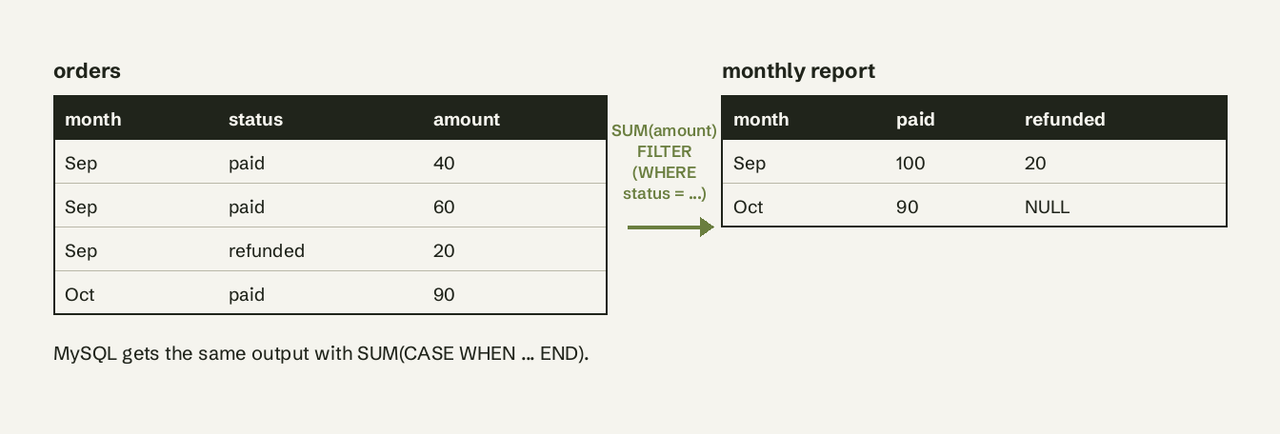
Postgres is better for SQL-heavy work, and roughly equal for simple CRUD. The difference shows up the moment you write a report. Take a SaaS orders table and ask: revenue per month, split by paid and refunded, plus the median order size.
In PostgreSQL:
-- PostgreSQL: one pass, no subqueries
SELECT date_trunc('month', created_at) AS month,
       SUM(amount) FILTER (WHERE status = 'paid')     AS paid_revenue,
       SUM(amount) FILTER (WHERE status = 'refunded') AS refunded,
       percentile_cont(0.5) WITHIN GROUP (ORDER BY amount) AS median_order
FROM orders
GROUP BY 1
ORDER BY 1;
In MySQL there is no FILTER clause, so you fall back to CASE inside the aggregate, and there is no median function at all:
-- MySQL: CASE replaces FILTER; the median needs a window-function workaround
WITH ranked AS (
  SELECT DATE_FORMAT(created_at, '%Y-%m-01') AS month, amount, status,
         ROW_NUMBER() OVER (PARTITION BY DATE_FORMAT(created_at, '%Y-%m-01') ORDER BY amount) AS rn,
         COUNT(*)     OVER (PARTITION BY DATE_FORMAT(created_at, '%Y-%m-01')) AS cnt
  FROM orders
)
SELECT month,
       SUM(CASE WHEN status = 'paid' THEN amount END)     AS paid_revenue,
       SUM(CASE WHEN status = 'refunded' THEN amount END) AS refunded,
       AVG(CASE WHEN rn IN (FLOOR((cnt + 1) / 2), CEIL((cnt + 1) / 2)) THEN amount END) AS median_order
FROM ranked
GROUP BY month
ORDER BY month;
Both return the same numbers. One is four lines of intent, the other is a puzzle someone has to maintain. That pattern repeats across reporting work, which is why Postgres keeps winning analytics-flavored comparisons. More on the filtered-aggregate pattern in our guide to FILTER in SQL and conditional logic with CASE WHEN.
Which is faster for analytics queries?
Neither is categorically faster; Postgres usually finishes analytics queries in less work because the planner has more tools. Single-row primary key lookups are fast on both. Where they differ:
- Index choice. Postgres has BRIN indexes for huge append-only tables (event logs, timestamps), partial indexes such as
CREATE INDEX ON orders (created_at) WHERE status = 'paid', and expression indexes. MySQL has functional key parts since 8.0.13 but no partial indexes. - PostgreSQL 18 I/O. The PostgreSQL 18 release notes list an asynchronous I/O subsystem for sequential scans, bitmap heap scans and vacuum, plus "skip scan" so a multicolumn B-tree index helps even when the query does not filter on its first column. Both matter for reporting scans.
- Precomputation.
CREATE MATERIALIZED VIEW monthly_revenue AS ...plusREFRESH MATERIALIZED VIEWgives dashboards a cached table. MySQL has no materialized views; you build and refresh a summary table yourself. - Parallel query. Postgres can split a large scan or aggregate across worker processes. Treat any blog benchmark with suspicion unless it lists versions, hardware and the exact query: results flip with indexing and configuration.
At real analytics scale (hundreds of millions of rows, many concurrent dashboard users) the honest answer is neither: copy the data into a warehouse such as BigQuery or ClickHouse.
How do JSON and data types compare?
Postgres treats JSON as a first-class, indexable type. Its jsonb stores a decomposed binary form, so per the JSON types docs it is faster to query and supports GIN indexes for containment queries:
-- PostgreSQL: index every key in a jsonb column, then query by containment
CREATE INDEX idx_events_props ON events USING GIN (props);
SELECT count(*) FROM events WHERE props @> '{"plan": "pro"}';
MySQL's JSON type is also stored in binary, but you index it by extracting a path into a generated column (or a multi-valued index for arrays):
-- MySQL: index one JSON path through a generated column
ALTER TABLE events
  ADD COLUMN plan VARCHAR(20) AS (props->>'$.plan') STORED,
  ADD INDEX idx_plan (plan);
SELECT COUNT(*) FROM events WHERE plan = 'pro';
The MySQL way works well when you know the hot paths in advance. Postgres wins when you don't. Beyond JSON, Postgres has arrays, ranges, timestamptz, enums, domains and, as of 18, uuidv7() for time-ordered keys. See our notes on Postgres timestamptz and bigint in PostgreSQL.
What about data integrity and schema changes?
Postgres is stricter, and that saves you from silent bad data. Three concrete differences:
- Transactional DDL. In Postgres,
BEGIN; ALTER TABLE ...; UPDATE ...; ROLLBACK;undoes the schema change too. In MySQL, DDL statements cause an implicit commit, so a migration that fails halfway leaves the schema half-changed. - CHECK constraints. MySQL only enforces
CHECKfrom 8.0.16 (MySQL docs); before that it parsed and ignored them. Anyone on an older MySQL may believe constraints exist that never ran. Postgres has always enforced them. - Storage engines. MySQL's ACID guarantees and MVCC depend on InnoDB. Tables on MyISAM get neither. Postgres has one engine with MVCC everywhere.
Default isolation also differs: Postgres uses Read Committed, InnoDB uses Repeatable Read. Code ported between them can see different results under concurrency, so test that path deliberately.
Upserts, RETURNING and writing data
Postgres gives you more control over writes. INSERT ... ON CONFLICT DO UPDATE and MERGE (since PostgreSQL 15) both exist, and PostgreSQL 18 lets RETURNING show both the OLD and NEW row:
-- PostgreSQL 18: upsert and see what changed
INSERT INTO customers (email, plan) VALUES ('ana@example.com', 'pro')
ON CONFLICT (email) DO UPDATE SET plan = EXCLUDED.plan
RETURNING old.plan AS previous_plan, new.plan AS current_plan;
MySQL's equivalent is INSERT ... ON DUPLICATE KEY UPDATE, with no RETURNING, so you need a second SELECT to read the result.
When should I choose MySQL over Postgres?
Choose MySQL when its strengths match your app and the missing features don't:
- Simple, read-heavy web apps. Blogs, CMSs and storefronts doing primary key lookups. WordPress, for example, targets MySQL and MariaDB.
- Your team already runs it well. Operational experience with backups, replication and tuning beats feature lists.
- Your platform is MySQL-first. Vitess-based hosting and many shared hosts are built around MySQL.
- Connection handling. Postgres uses a process per connection, so thousands of client connections need a pooler such as PgBouncer. MySQL's thread-per-connection model is lighter out of the box.
- Long, predictable support. MySQL 9.7 LTS has premier support until April 2031, slightly longer than a Postgres major version's 5 years.
Is it hard to migrate from MySQL to Postgres?
It is moderate work: data moves easily, SQL needs rewriting. Plan for these:
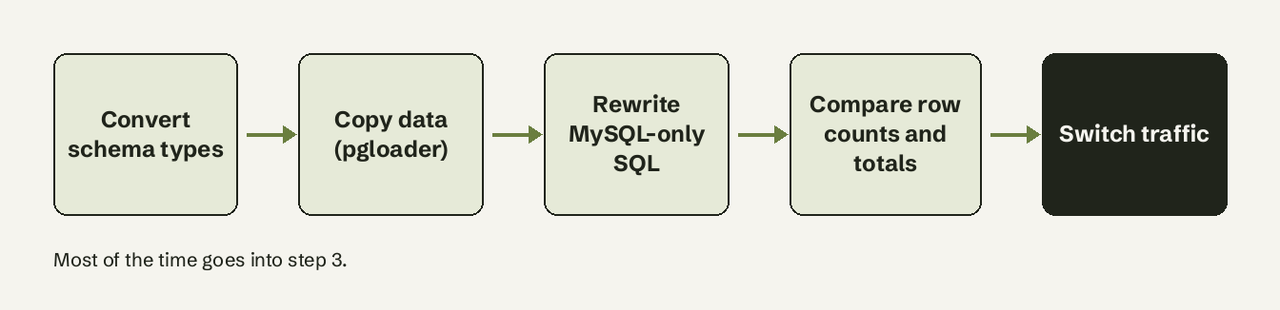
- Types.
TINYINT(1)becomesboolean,DATETIMEusually becomestimestamptz,AUTO_INCREMENTbecomes an identity column, unsigned integers need a larger type or aCHECK. - Data copy. pgloader can read a MySQL database and load Postgres in one command, including schema conversion.
- SQL dialect. Backtick identifiers become double quotes,
IFNULLbecomesCOALESCE,DATE_FORMATbecomesto_char,GROUP_CONCATbecomesstring_agg,ON DUPLICATE KEY UPDATEbecomesON CONFLICT. Our PostgreSQL DATEADD and DATEDIFF guides cover the date-function swaps. - Case sensitivity. Postgres string comparison is case-sensitive by default; MySQL's default collations are not. Queries like
WHERE email = 'Ana@x.com'change behavior. - Validation. Compare row counts and sums per table before cutting over.
Which should you pick?
Pick Postgres for reports or dashboards on the same database, JSON queried by arbitrary keys, constraints you can trust and migrations that roll back cleanly. That covers most new SaaS products.
Whichever you run, the next problem is usually the same: people outside engineering need answers from it without writing the SQL above. AI for Database connects to both PostgreSQL and MySQL, answers plain-English questions with the SQL it ran, and turns them into dashboards and alerts. Try AI for Database free at aifordatabase.com, sample data included.
Frequently Asked Questions
Is PostgreSQL better than MySQL for beginners?
Both are fine to learn on, and core SQL (SELECT, JOIN, GROUP BY) is the same. MySQL is slightly easier to install on shared hosting; Postgres follows the SQL standard more closely, so what you learn transfers better to warehouses like BigQuery and Snowflake.
Why do developers prefer Postgres?
Mostly for features: jsonb with indexes, FILTER and percentile aggregates, MERGE and RETURNING, transactional DDL, extensions such as PostGIS and pgvector, and a permissive license. Managed options like Supabase, Neon and Amazon RDS also made running it easy.
Is Postgres slower than MySQL?
Not in general. Simple primary key reads perform similarly. MySQL can be quicker for very high connection counts without a pooler; Postgres is usually quicker on complex joins and aggregates because of richer indexes and parallel query. Benchmark your own queries on your own versions.
Does MySQL support window functions and CTEs?
Yes, since MySQL 8.0. If you are on 5.7 or older, you have neither, which is a strong reason to upgrade or switch.
Is MySQL still maintained in 2026?
Yes. Oracle ships an LTS line (9.7, released April 2026, supported to 2031) and short-lived innovation releases (26.10, October 2026).
Can I use both?
Yes. Many teams keep MySQL for an existing app and use Postgres for new services or reporting replicas. A tool that connects to both lets you query them side by side; see our pages on [PostgreSQL](https://www.aifordatabase.com/databases/postgresql/) and [MySQL](https://www.aifordatabase.com/databases/mysql/) connections.