
Most Accurate Text-to-SQL Tools for Enterprise Schemas
TL;DR: No text-to-SQL tool is reliably accurate on a raw enterprise schema: the BEAVER benchmark (revised May 2026) found state-of-the-art agents using GPT-5.2 at 10.8% accuracy on real private warehouses. Accuracy comes from context (table descriptions, verified example queries, a semantic model) and from answers you can check. AI for Database is our pick for teams without a data team, because every answer shows its SQL, runs read-only, and can be pinned and watched; Snowflake Cortex Analyst and Databricks Genie are the most accurate options when a data team can model one warehouse.
Try AI for Database free at aifordatabase.com (sign up, sample data included).
The most accurate text-to-SQL tools on complex enterprise schemas are the ones that do not rely on the model alone. Snowflake Cortex Analyst (with a semantic model), Databricks Genie (with curated table descriptions and example queries), and open-source frameworks like Vanna and Wren AI (with retrieval over your own schema and past queries) all add context before they write SQL. AI for Database takes a different route for small teams: it connects to the live database, answers in plain English, and shows the SQL and the tables it used on every answer so a person can verify it. Nobody, including us, has published vendor-neutral accuracy numbers on Spider 2.0 or BEAVER for these products, so treat any single "accuracy %" on a vendor page as their own test.
Why do text-to-SQL tools fail on enterprise schemas?
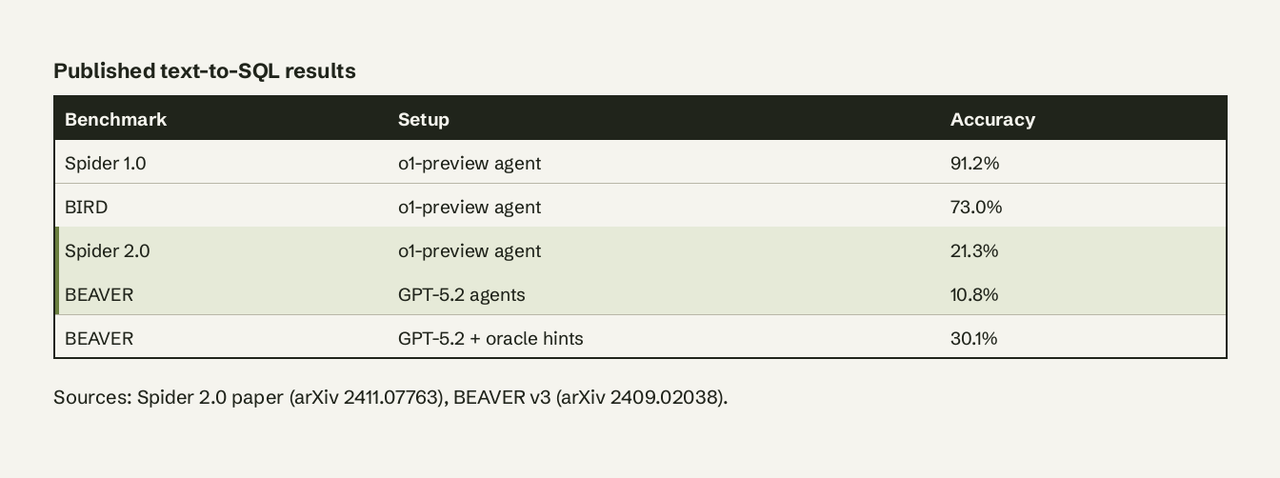
Text-to-SQL tools fail on enterprise schemas because the question needs knowledge that is not in the column names. The Spider 2.0 paper built 632 real workflow problems on databases that often have over 1,000 columns in BigQuery and Snowflake, and found an o1-preview code agent solved 21.3% of them, against 91.2% on the older Spider 1.0 and 73.0% on BIRD.
The BEAVER benchmark goes further: 9,128 question-SQL pairs from real query logs across 812 tables and 19 domains in private data warehouses. In its May 2026 revision, state-of-the-art agentic frameworks with GPT-5.2 reached 10.8%. Given oracle hints for each subtask (which tables, which join, what the business term means), they reached 30.1%. The authors conclude the bottleneck is resolving those subtasks, not writing SQL syntax.
In practice the failures look like this:
- Ambiguous names.
amt,amt_net,amt_adjin three tables; only finance knows which one is "revenue". - Wrong join paths. Two foreign keys to
users, one for the buyer and one for the sales rep. - Hidden business rules. "Active customer" excludes test accounts and refunded orders.
- Dialect detail. Date functions differ between Postgres, SQL Server and BigQuery.
A query can run without errors and still return the wrong number. That is why "does it execute" is the wrong test.
What accuracy do LLMs reach on enterprise benchmarks like BEAVER and Spider 2.0?
LLMs reach roughly 10% to 30% on enterprise benchmarks today, depending on how much help they get. The published figures, read on 2026-11-23:
| Benchmark | What it measures | Best published setup | Accuracy |
|---|---|---|---|
| Spider 1.0 | Clean academic schemas | o1-preview agent | 91.2% |
| BIRD | Larger, dirtier academic DBs | o1-preview agent | 73.0% |
| Spider 2.0 | 632 enterprise workflows, 1,000+ column DBs | o1-preview agent | 21.3% |
| BEAVER (v3, May 2026) | 9,128 pairs from private warehouses | GPT-5.2 agentic frameworks | 10.8% |
| BEAVER with oracle hints | Same, with subtask answers given | GPT-5.2 agentic frameworks | 30.1% |
Vendor pages often quote 85% to 95%. Those numbers come from the vendor's own tests on modeled data, usually after someone wrote a semantic model. They are not wrong, but they measure a different thing: accuracy after a data team has done the context work.
Which features improve text-to-SQL accuracy on large schemas?
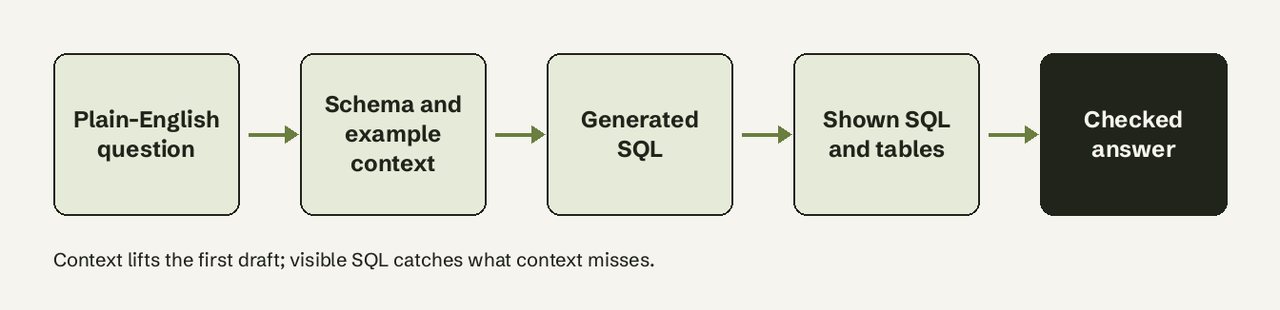
Five features move accuracy on real schemas, and every tool below is judged on them:
- Schema context. Table and column descriptions, so
amt_netmeans something. - Verified examples. Known-good queries the tool can copy patterns from.
- A semantic model or metric definitions. "Revenue" defined once, reused everywhere.
- Visible SQL and sources. The answer shows its query and tables so a person can check it.
- Read-only, scoped access. A wrong query cannot change data.
How we judged
We ranked the tools on the five features above, plus who can run them without a data team and the published price. We did not run our own accuracy benchmark, and we do not repeat vendor accuracy claims as fact. Prices were read on each vendor's own page on 2026-11-23.
| Tool | Best for | Schema context | Shows SQL | Data sources | Starting price |
|---|---|---|---|---|---|
| AI for Database | Teams without a data team | Reads live schema | Yes, every answer | Postgres, MySQL, SQL Server, Oracle, MongoDB, Sheets and more | Pro $20 per user per month |
| Snowflake Cortex Analyst | Snowflake estates | Semantic model (YAML / semantic views) | Yes | Snowflake only | Snowflake usage |
| Databricks Genie | Databricks estates | Descriptions, example queries, Unity Catalog | Yes | Unity Catalog, up to 50 tables per agent | Databricks usage |
| Vanna | Developers building their own assistant | Retrieval over schema and past queries | Yes | Any SQL DB you wire up | Free, MIT licence |
| Wren AI | Self-hosted semantic layer | Modeling layer | Yes | Multiple sources | Open source free; cloud $179 |
| Hex (Threads) | Data teams publishing to business users | Data-team curated context | Yes | Warehouses | $36 or $75 per editor |
| AI2SQL | Drafting SQL by hand | Schema you paste or connect | Yes | Common SQL DBs | $9 per month |
1. AI for Database: checkable answers, no modeling project
AI for Database is an AI data-intelligence platform for teams without a data team. You connect a live database or spreadsheet, ask in plain English, and get the answer with its SQL. The homepage puts it as "Ask my database anything. In plain English." Each answer carries a View SQL link and a Read-only marker, so a non-technical user can hand it to an engineer when a number looks off.
What it does for accuracy on a messy schema:
- No modeling project. Connect the live database and start asking the same day; nobody has to write YAML first.
- Follow-up questions. Narrow an answer ("only enterprise customers", "exclude test accounts") instead of re-asking from scratch.
- A receipt on every answer. The site calls it that: "every answer ships with its receipt". Pro lets you save them and inspect the SQL.
- From answer to monitoring. Pin a checked answer to a dashboard, or watch it with a workflow that sends Slack, email or webhook alerts when the data changes.
Sources: PostgreSQL, MySQL, MongoDB, SQL Server, SQLite, Oracle, Redis, Firebase, Google Sheets, Salesforce, HubSpot, Notion and Airtable, on AWS, Azure, GCP or self-hosted.
Pricing (pricing page, 2026-11-23): Pro $20 per user per month, paid as credits that never expire; Team $50 per user per month with unlimited AI usage, audit logs and shared dashboards; Enterprise custom, with self-hosting.
Where it stops: it does not offer a hand-authored semantic layer like Cortex Analyst's YAML or dbt metrics. If you have a data team that wants to govern every metric definition centrally across a warehouse, a warehouse-native tool fits better. For a founder or ops lead with a Postgres or MySQL database and no analyst, it gets to a checkable answer fastest.
2. Snowflake Cortex Analyst
Cortex Analyst is Snowflake's managed text-to-SQL service. Its documentation says generic AI struggles with text-to-SQL and that it overcomes this "by using a semantic model": a YAML file or semantic view that maps business terms, synonyms and verified queries to your tables.
- Best for: teams whose data already lives in Snowflake and who have someone to write and maintain the semantic model.
- Accuracy driver: the semantic model. The more verified queries and synonyms you add, the less it guesses.
- Limits: Snowflake only; the semantic model is work you own.
- Pricing: billed through Snowflake usage, not a separate seat price.
3. Databricks Genie
Genie is Databricks' natural-language agent over Unity Catalog. According to the Genie setup docs, data must be registered in Unity Catalog and an agent can hold up to 50 tables, views or metric views. Genie Code reads your data and suggests table descriptions and example queries, and Genie searches popular workspace queries on those tables for more context.
- Best for: Databricks-first teams with modeled data.
- Accuracy driver: curated descriptions, sample queries and instructions per agent.
- Limits: Databricks only; 50 tables per agent means large schemas get split into several agents.
- Pricing: Databricks usage.
Two details from the same docs matter at scale. Each Genie agent supports up to 200,000 conversations, each with up to 10,000 messages. And when Genie looks for popular workspace queries to learn from, it uses your own credentials, so it only finds queries you hold at least CAN VIEW permission on: Unity Catalog grants shape what context the agent sees.
4. Vanna
Vanna is an open-source Python framework, MIT licensed, described as "Accurate Text-to-SQL Generation via LLMs using Agentic Retrieval". You feed it your DDL, documentation and known-good SQL, and it retrieves the relevant pieces for each question.
- Best for: engineering teams building an internal assistant.
- Accuracy driver: the quality of the training examples you give it.
- Limits: you host, wire and maintain it; accuracy drifts when the schema changes and nobody updates the examples.
- Pricing: free and open source.
5. Wren AI
Wren AI grounds SQL generation in a modeling layer across multiple sources. Its repository ships under AGPL-3.0 and Apache-2.0 licences. Per its pricing page, the open-source edition is "the free CLI and context engine for developers, no UI"; cloud plans list at $179 and $559 per month with a 14-day trial.
- Best for: teams that want a self-hosted semantic layer and own the stack.
- Accuracy driver: the model definitions you write.
- Limits: the free edition has no UI for business users.
6. Hex (Threads)
Hex is a notebook platform for data teams. Its Threads feature lets business users ask questions in natural language over context the data team curates. Hex pricing lists $36 and $75 per editor per month, with Threads on the higher tiers.
- Best for: companies with analysts who publish trusted context to the rest of the business.
- Accuracy driver: data-team curation and reviewable SQL and Python.
- Limits: assumes a data team exists; per-editor pricing.
7. AI2SQL
AI2SQL generates, fixes and optimises SQL from plain English. AI2SQL pricing starts at $9 per month for 100 SQL queries, with $19 and $39 tiers and a 7-day trial.
- Best for: people who write SQL and want a faster first draft.
- Accuracy driver: the schema you give it, plus your own review.
- Limits: a drafting tool, not a governed analytics layer; you still run and check the query yourself. See our [AI2SQL alternative comparison](/compare/ai2sql-alternative/).
How do you test a text-to-SQL tool on your own schema?
Test a text-to-SQL tool with 20 to 30 questions your team already knows the answers to. Benchmarks tell you the ceiling; your schema tells you the truth.
- Write a gold set. Take 20 to 30 real questions from Slack or past reports, with the correct SQL and the correct number for each.
- Include the hard ones. At least five questions that need a business rule ("active customer"), five that need a two-hop join, and five with date logic.
- Score result match, not execution. A query that runs but returns 1,204 instead of 1,198 is a fail.
- Score with and without context. Run once on the raw schema, then again after adding descriptions or examples. The gap is the work you will be maintaining.
- Check the SQL on every miss. If the tool does not show its SQL, you cannot tell a wrong join from a wrong filter.
-- Gold-set check: compare the tool's number with yours
SELECT COUNT(DISTINCT o.customer_id) AS active_customers
FROM orders o
JOIN customers c ON c.id = o.customer_id
WHERE o.created_at >= CURRENT_DATE - INTERVAL '30 days'
  AND o.status <> 'refunded'
  AND c.is_test = false;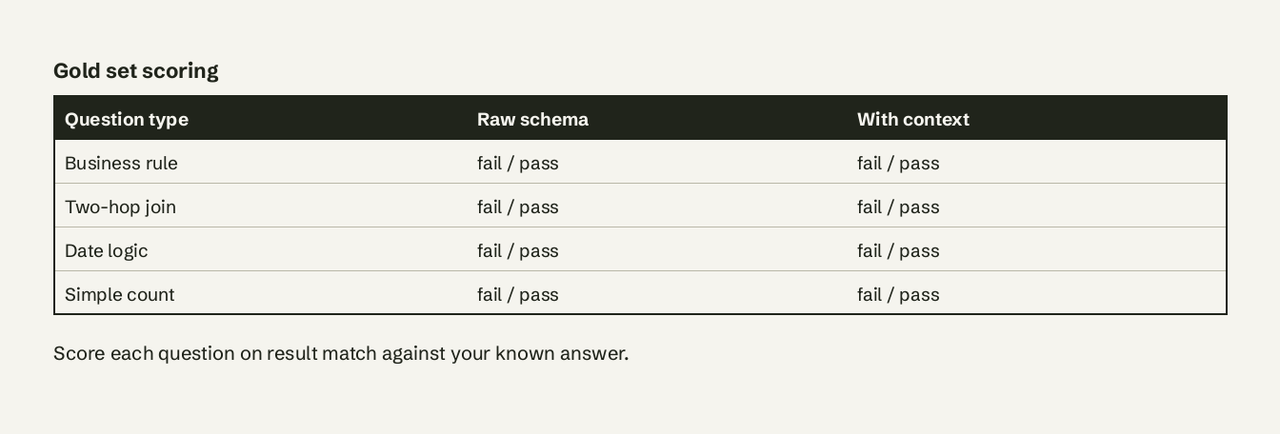
How to choose
- No data team, data in Postgres, MySQL, SQL Server or a SaaS tool: start with AI for Database. You get checkable answers on day one, and the same answer becomes a dashboard or an alert.
- Everything in Snowflake, with someone to own a semantic model: Cortex Analyst.
- Everything in Databricks: Genie.
- Engineers who want to build their own assistant: Vanna or Wren AI.
- Analysts publishing to business users: Hex.
- You write SQL and want drafts: AI2SQL, or a general model (see [the best LLM for SQL generation](/blog/best-llm-for-sql-generation/)).
For a wider list of tools, see our [natural language database query tools roundup](/blog/best-natural-language-database-query-tools-2026/) and [chat with your database tools](/blog/chat-with-your-database-best-tools-2026/). If AI agents will query the database, read [database tools for AI agents](/blog/best-database-tools-for-ai-agents-2026/).
Frequently Asked Questions
Which text-to-SQL tool is the most accurate?
None is proven most accurate on enterprise schemas: no vendor has published independent Spider 2.0 or BEAVER results for its product. On modeled single-warehouse data, Cortex Analyst and Genie do well because a data team supplies context. For teams without a data team, the most reliable setup is a tool that shows its SQL on every answer, such as AI for Database.
Is text-to-SQL accurate enough for production?
For simple questions on clean schemas, often yes. For enterprise schemas, published benchmarks say no without help: 21.3% on Spider 2.0 and 10.8% on BEAVER. Production use needs context, read-only access and visible SQL so people catch the misses.
Does a bigger model fix text-to-SQL accuracy?
Not on its own. BEAVER's own result is the evidence: GPT-5.2 agents went from 10.8% to 30.1% when given hints about the subtasks, with the same model. Context about tables, joins and business terms matters most.
Do I need a semantic layer for text-to-SQL?
You need one if many people must get the same number for the same metric across a large warehouse. A small team on one database can start without it, as long as answers show their SQL and someone checks the important ones.
Can I try a text-to-SQL tool on my own database safely?
Yes, if it connects read-only. AI for Database runs answers read-only and shows the SQL; sample data is included if you want to try it before connecting your own database. Try AI for Database free at aifordatabase.com ([start free](https://app.aifordatabase.com/signup)) and ask your own database the five hardest questions from your gold set.