
Databricks Genie vs Snowflake Cortex Analyst: Text-to-SQL
TL;DR: Databricks Genie and Snowflake Cortex Analyst both turn plain-English questions into SQL, but each only works on its own platform: Genie on Unity Catalog tables with a pro or serverless SQL warehouse, Cortex Analyst on Snowflake data described by a semantic view. Pick the one that matches the warehouse you already run. If your data lives in PostgreSQL, MySQL, Supabase or SaaS apps and you have no data team to build a semantic model, AI for Database is the shorter path.
Try AI for Database free at aifordatabase.com: start with sample data.
How does Databricks Genie compare with Snowflake Cortex Analyst for text-to-SQL? Genie (Genie Agents, formerly Genie Spaces) is a chat interface inside Databricks that a data analyst configures with up to 50 Unity Catalog tables, example SQL and instructions; business users then chat with it. Cortex Analyst is a fully managed REST API inside Snowflake that answers questions from a semantic view (or semantic model YAML) and that Snowflake now recommends using through Cortex Agents. Genie ships a ready chat UI; Cortex Analyst is API-first, so you build or embed the front end. Genie One and Genie Agents usage is free until January 31, 2027 (compute billed); Cortex Analyst bills per successful message plus warehouse time.
Comparison table
| Criteria | AI for Database | Databricks Genie | Snowflake Cortex Analyst |
|---|---|---|---|
| Where your data must be | PostgreSQL, MySQL, SQL Server, Oracle, SQLite, MongoDB, Supabase, BigQuery, Google Sheets, HubSpot and more | Unity Catalog in Databricks | Snowflake |
| Context it needs first | None required; schema is read on connect | Up to 50 tables, example SQL, instructions (Genie Code can draft them) | Semantic view or semantic model YAML |
| Interface | Chat, dashboards, alerts in the web app | Genie One chat UI, mobile app | REST API (build your own UI, Streamlit, Slack) |
| Price (read 2026-11-15) | Free with sample data; Pro $20/user/month in credits; Team $50/user/month unlimited AI | Genie One and Agents LLM usage free until Jan 31, 2027; SQL compute billed | Credits per successful message; warehouse cost extra |
| After the answer | Pin to self-refreshing dashboard, set Slack/email/webhook alerts | AI/BI dashboards in Databricks | Whatever your app builds |
| Who sets it up | The person asking | A data analyst with warehouse and Unity Catalog rights | A developer plus a semantic model owner |
Sources: Databricks Genie docs, Genie Agent setup, Databricks Genie pricing, Cortex Analyst docs, AI for Database pricing, all read November 15, 2026.
What AI for Database does for this job
AI for Database answers data questions in plain English on the databases a company already has, shows the SQL behind every answer, and keeps going after the answer:
- Ask: "Show me revenue by country last 30 days" runs as a read-only query and returns a table or chart with its SQL.
- Dashboards: pin answers to dashboards that refresh on a schedule.
- Action workflows: "when daily signups drop below 50" can send a Slack alert, an email or call a webhook.
- No semantic model project: you connect a database and ask. There is no YAML file or metric view to write first.
Where it does not fit: AI for Database does not list Databricks as a source, and it is not built to sit inside a governed Snowflake or Databricks estate with Unity Catalog or Snowflake RBAC as the policy layer. If your company already pays for one of those platforms and has a data team, use the native tool. Our Databricks Genie alternative and Snowflake Cortex Analyst alternative guides cover that choice in more depth.
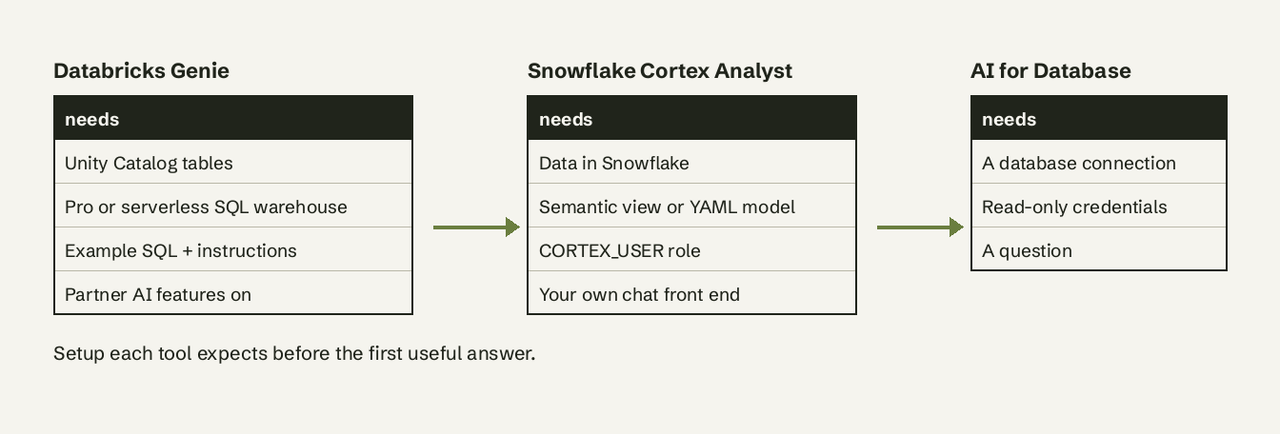
What does each need before it works?
Genie needs Databricks plumbing; Cortex Analyst needs a semantic model.
Databricks Genie. Per the setup docs, data must be registered in Unity Catalog, and an agent can hold up to 50 tables, views or metric views. It runs on a pro or serverless SQL warehouse, and the creator needs the Databricks SQL entitlement, CAN USE on the warehouse and SELECT on the data. Partner-powered AI features must be on at both account and workspace level. When you create an agent, Genie Code reads your data and suggests table descriptions and example queries; Databricks recommends adding example SQL, instructions and knowledge store entries before sharing.
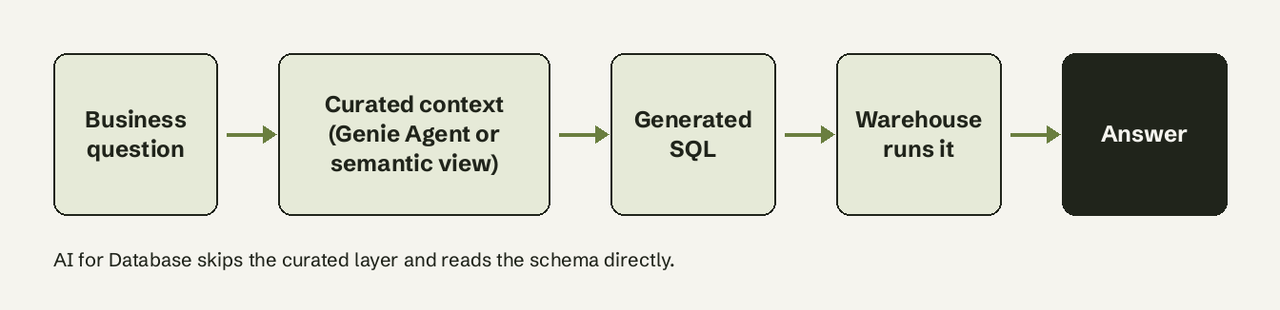
Snowflake Cortex Analyst. Cortex Analyst reads a semantic view that defines logical tables, dimensions, facts, metrics and relationships. Snowflake's own reasoning: a raw schema lacks business definitions, so the semantic model supplies them. Access goes through the CORTEX_USER role (granted to PUBLIC by default) or the narrower CORTEX_ANALYST_USER database role.
How do they differ on the interface?
Genie is a product; Cortex Analyst is a building block. Genie One gives business users a chat UI, an account-level entry point and iOS and Android apps. Cortex Analyst is a REST API: you pass a messages array with the conversation history and get text plus SQL back. Snowflake suggests putting it inside Streamlit apps, Slack, Teams or custom chat front ends.
{
  "messages": [
    {"role": "user", "content": [{"type": "text", "text": "What was revenue by region last quarter?"}]}
  ],
  "semantic_view": "SALES_DB.PUBLIC.REVENUE_SV"
}
What do Genie and Cortex Analyst cost?
Genie: Genie One and Genie Agents usage is free through January 31, 2027; service principals are billed. The free part covers Genie LLM usage only: the SQL Serverless compute behind each answer is billed, with Databricks quoting 150 DBUs at $10.50 in US East. Genie Code moved to pay-as-you-go on July 8, 2026 with a per-user free monthly allowance (Databricks pricing).
Cortex Analyst: credits per message processed, at the rate in Snowflake's Service Consumption Table. Only successful (HTTP 200) responses count, and token count does not change the price unless you call it through Cortex Agents. Running the generated SQL costs warehouse credits on top. You can track spend with:
SELECT * FROM SNOWFLAKE.ACCOUNT_USAGE.CORTEX_ANALYST_USAGE_HISTORY;AI for Database: free start with sample data, Pro at $20 per user per month paid as credits that never expire, Team at $50 per user per month with unlimited AI usage, Enterprise custom with self-hosting.
Accuracy and limits
Both vendors tie accuracy to context. Databricks tells you to tune agents with metrics, business rules and verified answers. Snowflake lists known Cortex Analyst limits in multi-turn chats: it cannot see results of earlier queries ("revenue of the second product" fails), it only answers questions SQL can resolve (not "what trends do you observe?"), and long, shifting conversations should be reset. By default Cortex Analyst runs on Snowflake-hosted Mistral and Meta models, so prompts and metadata stay inside Snowflake; accounts outside native regions use cross-region inference. For more on why text-to-SQL breaks on real schemas, see the text-to-SQL performance cliff.
Which one should your team pick?
- Choose AI for Database if your data is in PostgreSQL, MySQL, Supabase, BigQuery or SaaS tools, nobody owns a semantic layer, and you want answers, dashboards and alerts in one place this week.
- Choose Databricks Genie if you already run Databricks with Unity Catalog and an analyst can curate agents with example SQL and instructions.
- Choose Snowflake Cortex Analyst if you are on Snowflake, have developers to build the front end, and want governed answers through Snowflake RBAC, ideally through Cortex Agents.
See also: best text-to-SQL tools and semantic layer vs metrics layer.
Frequently Asked Questions
Is Databricks Genie the same as Genie Spaces?
Yes. Genie Agents were formerly called Genie Spaces. Genie One is the business-user interface that runs on top of them.
Does Cortex Analyst need a semantic model?
Yes. It uses a semantic view or semantic model YAML that defines tables, dimensions, facts, metrics and joins. Snowflake recommends semantic views.
Is Databricks Genie free?
Genie One and Genie Agents LLM usage is free through January 31, 2027, except for service principals. SQL warehouse compute is billed.
Can Cortex Analyst query data outside Snowflake?
No. Generated SQL runs in your Snowflake virtual warehouse against Snowflake data.
When does AI for Database fit better than either?
When your data is not in Databricks or Snowflake, or when no one has time to build and maintain a semantic model. You connect, ask, and pin answers to dashboards and alerts. Try AI for Database free at aifordatabase.com: [sign up and ask your first question](https://app.aifordatabase.com/signup).